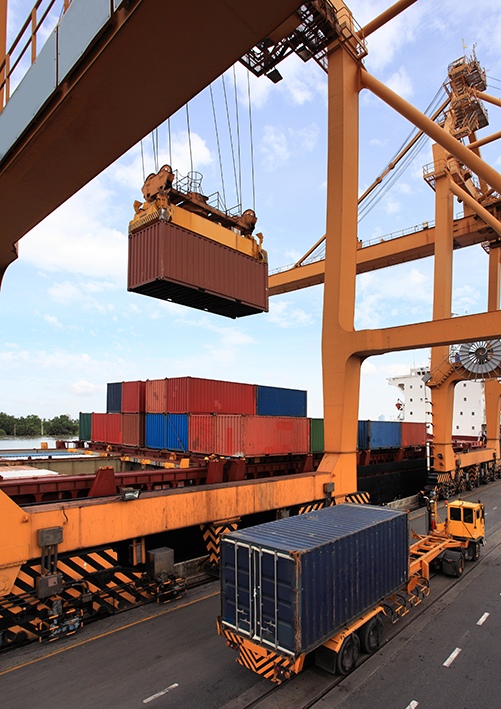
The line between disorder and order lies in logistics

“The line between disorder and order lies in logistics”. This simple yet concise summary of the impact of logistics is attributed to Sun Tzu, a Chinese general.  The general’s quote indicates that there are implications associated with failure to accurately implement all associated logistical activities which include demand forecasting, site selection, procurement and inventory management and customer service to mention a few.
In the words of Shakoer Baderoen, “Logistics makes the world go around and without it everything will be misplaced and unorganised”. The burning question is, what exactly is logistics? And a simple textbook answer will be, “the end goal of logistics is the delivery of the finished goods, required by the marketing department to the point where they are needed in the most economical way?”. However, this leaves the reader with more questions regarding the role. Thus, for the current blog, we have united young logistics coordinators in the fresh fruit export industry to discuss what the role means to them.  The general theme in their responses to the question was the desire to optimise customer satisfaction by reducing lead time.  
For Shakoer Baderoen, a logistics coordinator at FREIGHT LOGISTICS4U (Pty) Ltd, ensuring that all relevant information is distributed to all stakeholders in the supply chain is synonymous to logistics. This directly links to one of the key responsibilities of a logistics coordinator which is normally stated as “Pro-active communication to clients” on job advertisements. Within the export industry, the relevant information to be communicated with stakeholders/clients include updates on the sailing schedules and the implications on volumes to be moved, monitoring volumes booked against forecasted volumes to shipping lines and updating clients on whether all containers have been shipped on board the targeted vessel.
The shipping/export industry is subject to change and thus requires professionals who can communicate these changes timely and manage uncertainties. For example, trade restrictions with Russia in the wake of the Ukraine War left South African fruit growers and exporters uncertain on the future of the Russian market. For the citrus industry, this would have severe implications considering that Russia is a major importer of South African citrus (lemons, grapefruit, mandarins, and oranges). The Citrus Growers’ Association of Southern Africa (CGA) estimated that 14.8 million cartons (17 kg each) of grapefruit will be ready to be exported this 2022 season to Russia. Therefore, failure to do so will have detrimental impact on the total export volume. As a result, exporters will have to redistribute their produce. Speaking to Food for Mzansi, CGA CEO Justin Chadwick indicated that the United States and India will be best suited to absorb fruit previously destined for the Russian market. This change of market necessitates logistics coordinators to communicate, arrange reinspection and relabelling of the fruit, adhering to the new market standards.
Therefore, specific skills are required to be able to do that. According to Thando Mnisi, a junior accountant with the X Group, her flexibility and adaptability enables her to succeed in her role. She further elaborated that one of her greatest strengths is the ability to embrace change and her willingness to be taught and to learn.  While Shakoer shared that his analytical and logical skills together with multitasking enables him to efficiently perform his role. He further added that one needs to be able to think ahead and plan.

 The second key responsibility of a logistics coordinator is administrating and executing operations related tasks. The tasks include submitting bookings to shipping lines, collection of shipping information and monitoring reports generated from operating systems and updating the systems as required. With every administrative role, one needs to be meticulous. Thando emphasised on the importance of details and the fact that one has less room for error because incorrect information input can result in severe financial implications.  Shakoer added that, “all stakeholders want to make extra money so you as Logistics coordinator especially in the Export game, must be woke at all times and keep your faults to the minimum”.  

Clearly, logistics coordinators are not only concerned about planning, managing, and administering aspects of supply chain management, they understand that their role have an impact on the financial successes of the companies involved. As part of their responsibilities, they are required to assist finance and administration with a timeous solution of any queries and further they need to maintain low operational costs. Shakoer reduces his operation costs by making sure that all inputs are ready before the time, for the supply chain of goods to run as smooth as possible and this gives him sufficient time to adjust his planning accordingly and foresee any errors which might be costly if they are not amended earlier. As for Thando, her background in BCom in Supply Chain Management (University of Pretoria) helped her understand the fundamentals needed for optimisation of customer satisfaction, and in her current role.
In conclusion, logistics – supply chain management in general is constantly changing. Shakoer stated that global trade and supply chains are becoming more complex and intense because of the 4th industrial revolution being implemented. Thus, both Thando and Shakoer encouraged researching about the industry and connecting with mentors/career advisors in the same field. Lastly, “the internet has everything you need literally. It all depends on you if you are going to put it to WORK!”.
Compiled by:  Makhosazana Shantelle Ngwenya – AgriJob Blog Coordinator